A carbon fiber preform is a dry reinforcement structure created by braiding fibers into a shape close to the geometry of the final component. Forms such as tubes, airfoil profiles, beams, and conical bodies are prepared as fiber architectures before being converted into finished composite components.
ARER’s Focus in Braiding Technology
ARER focuses on producing carbon fiber preforms in different dimensions and cross-sectional geometries that continuously follow the contours of the intended product. In this way, the braid becomes more than a surface pattern; it forms the load-bearing fiber architecture of the final composite component.
Braided preforms can reduce the cutting, overlapping, and joining zones commonly found in flat fabrics. They also allow the fibers to continuously follow closed sections and geometric transitions. The braiding angle and fiber density can be adapted according to the loads the final product is expected to carry.
1. Tubes, Shafts, and Structural Members
Cylindrical carbon fiber preforms can be used for drive shafts, torque tubes, robotic arms, sensor supports, drone arms, lightweight masts, and structural tubes. The diameter, braiding angle, fiber density, and number of layers can be adapted to meet the requirements of each component.
Figure 1. Large-diameter dry carbon fiber tubular preform — representative image.

2. Airfoils and Aerodynamic Profiles
Braided preforms are not limited to circular cross-sections. Oval or teardrop-shaped fiber structures can be produced for airfoils, propeller and rotor bodies, control surfaces, and aerodynamic fairings. The preform surrounds the entire profile while maintaining the continuity of the braided structure.
Figure 2. Dry carbon fiber preform shaped according to an airfoil cross-section — representative image.

3. Variable-Cross-Section Beams
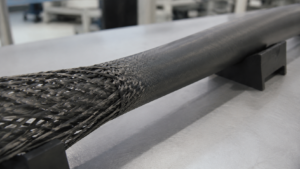
Preforms transitioning from a narrow tube to a wider oval profile can be used for lightweight chassis components, suspension arms, robotic structures, wing spars, and connecting parts. The braided structure follows the changing cross-section while allowing the fibers to remain as continuous as possible.
Figure 3. Carbon fiber beam preform transitioning from a narrow section to a wider profile — representative image.

4. Conical Bodies and Diameter Transitions
Conical preforms can be used in adapters connecting structures with different diameters, aerodynamic housings, telescopic structures, antenna or sensor fairings, and load-bearing bodies with changing diameters. As the braid transitions from a larger section to a smaller one, it continuously follows the surrounding geometry.
Figure 4. Dry carbon fiber conical preform transitioning from a larger diameter to a smaller diameter — representative image.

Key Application Areas for Braided Preforms
- Aerospace and unmanned systems: Wings, booms, tails, rotors, and structural body components.
- Automotive and mobility: Drive shafts, crash beams, suspension components, and lightweight chassis parts.
- Robotics and industrial systems: Lightweight robotic arms, axes, and structural tubes.
- Marine, sports, and advanced engineering: Masts, shafts, paddles, adapters, and load-bearing structures.
Conclusion
ARER’s braiding technology approaches carbon fiber as a preform that follows both the geometry and the load path of the product. From tubes and airfoil profiles to variable-cross-section beams and conical bodies, different geometries can be created using the same fundamental braiding approach.
The final performance of the component depends on the preform design, the selected material system, and application-specific engineering validation.
Summary
Carbon fiber preforms produced with ARER braiding technology provide a flexible manufacturing foundation for lightweight, closed-section, variable-geometry, and load-bearing composite components.


